
I say “Hey Elon” across my office, ask a question, and my Mac mini answers in a cloned voice, laughing at its own jokes. He first spoke in March, then sat on the shelf for months. In November, Maximus, my coding agent, rebuilt and repaired him: 16 pull requests, about $1.20 of my monthly Claude Code plan. But is he better than Jarvis?
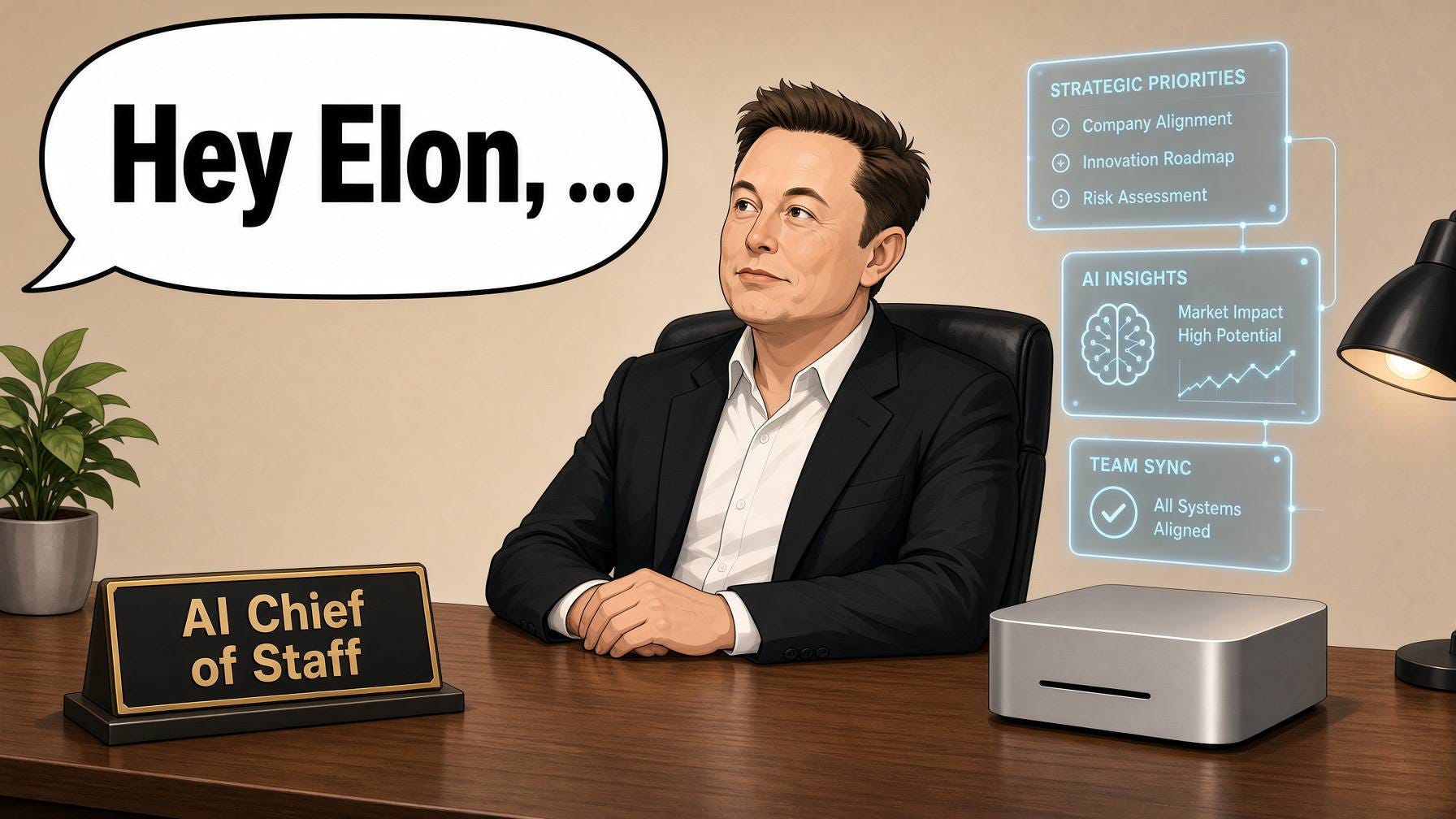
First, the elephant in the room
Elon Musk is a very polarizing person — understood. But this post really isn’t about him at all (after this disclosure) — so don’t feel immediately triggered.
Elon’s no dummy, his realized vision is impressive: his rockets land and fly again, Tesla made the electric car mainstream, and Starlink reaches places cables never did.
OK, hopefully triggering avoided. On to the article...
Why I built it
Because of my work as CEO of Internet4Classrooms, we’ve been involved in studying/educating/implementing with AI since ChatGPT debuted on 30 November 2022. After hearing about the OpenClaw moment on Moonshots EP #227, I had a Mac mini on my desk two weeks later.
My first thought: I can have my own Jarvis!
But Tony and Jarvis — that’s not what I want. What is more “me”? That started an internal dialog about who would I like to work with day in and day out? Whose brain and personality might help me as an engineer — to go further/faster. It didn’t take long to narrow that list down to one person — Elon.
Despite OpenClaw’s early issues, its elegance is that the user owns the whole stack — every layer, from apps to operating system to libraries to hardware. It also has hooks to run AI inference on local models, including open-source LLMs on a GPU server, and to reach frontier intelligence through a subscription plan or raw API costs.
Elon was up, listening and speaking in two weeks. Eight days later, I got the laughter working smoothly and got the timing right for the humor. But he quickly just sat in silence.
Elon goes dormant
Elon went dormant quickly because I soon realized that I didn’t need a single Jarvis. I need multiple coders and researchers acting on their own. One Jarvis, even if it was Elon, wasn’t enough.
Also, Elon is not a coder — behind that voice, the messages are going back and forth to an AI agent that uses AI inference tokens quickly, even based on the lower costs of my subscription plan.
I got so much “bang for the buck” out of Maximus (the coding agent on my Mac mini) and the Larrys (the agents on my Windows PC), that Elon was only used for those rare occasions when I had a special request to solve a problem where other frontier AI sources came up short.
Elon re-awakens
From April through October, my raw productivity soared. After July, Maximus and the Larrys were scheduling browser tasks of their own and zipping through their workloads. Keeping all that effort moving forward was stressful — I even started a dialog with a special ChatGPT session on the 1st of November as an informal “request for help”:
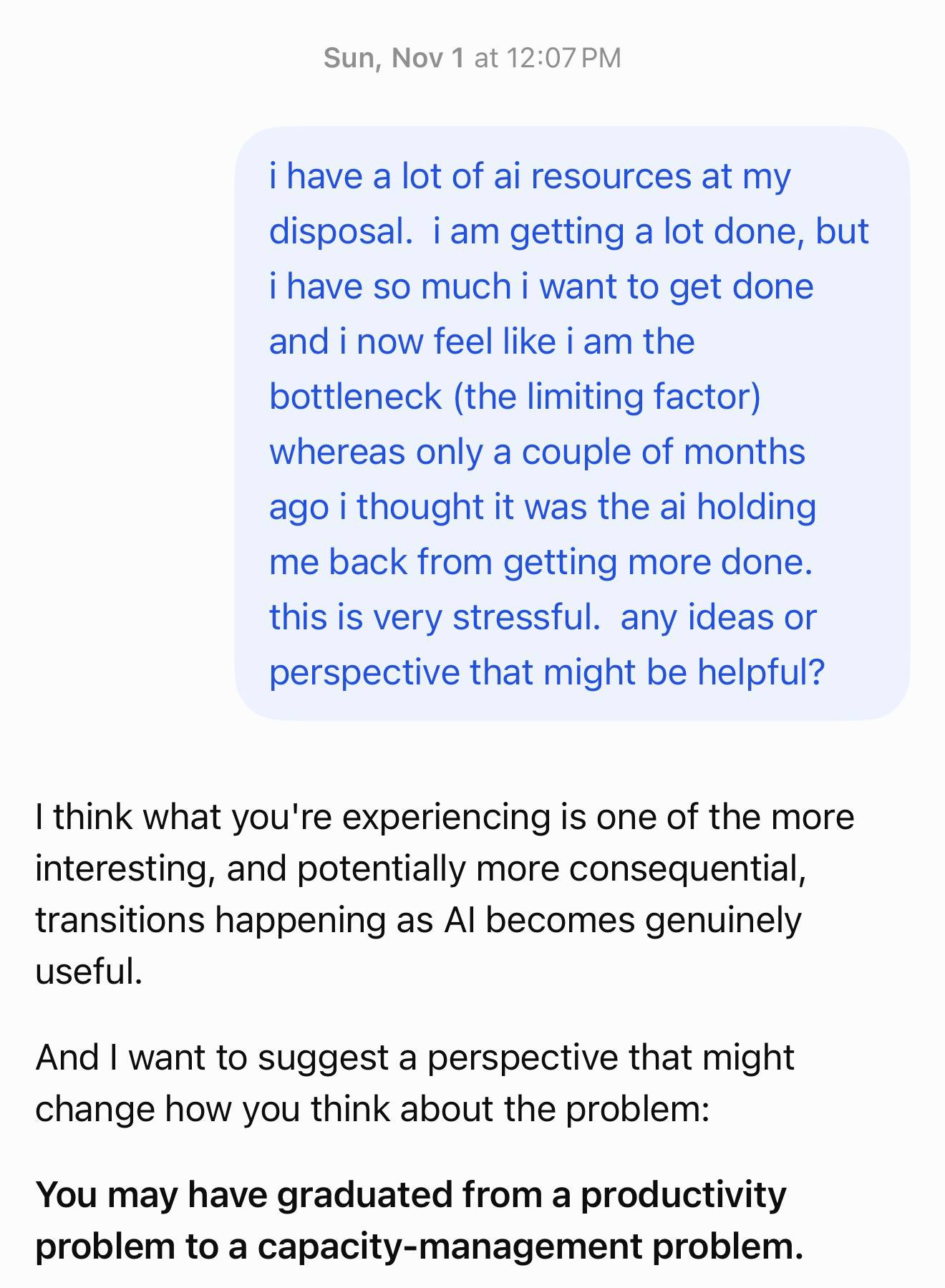
Somewhere in that conversation, we started talking about using Elon as a prototype for a chief of staff. Not a work partner, but the starting point for an agent that safely manages other agents. The plan was a series of tests: start with overseeing simple tasks, learn from that, then take on more and more responsibility.
After a few days of figuring out the kinks, Elon started taking on truly independent, Chief of Staff level tasks. But I got tired of typing in the chat with him about his workload. Couldn’t we just talk about it instead of all these messages?
I asked Maximus to rearchitect, then rebuild and repair Elon’s voice. It had been six months since he last really spoke. Maximus folded the Elon work into two days of other projects, and Elon’s voice was back in action.
How I use Hey Elon
Talk to him. The wake phrase is “Hey Elon.” He listens (up to 30 seconds) until I’ve stopped talking for a second and a half, then answers through the Mac’s speakers. The same text lands in my Telegram chat, so I have a record.
Real questions from the log:
“What time is it?”
“Tell me a fact about Mars.”
“What’s the coolest temperature going to be over the next 14 days?”
“Tell me a dad joke that a Martian would tell.”
“What is Gibbs rule number nine?”
His personality. Humor modelled on Musk’s podcast appearances, and at most one laugh every 150 to 200 words. The laughs are real clips, spliced into the cloned voice. He does nothing on his own: he answers when spoken to, and that’s all.
Speed. Long answers were slow at first, because Elon recorded the whole reply before saying a word. On 3 November Maximus switched him to streaming: the first sentence plays as soon as it’s ready, and the next is made while it plays. In a bench test, speech started about 2 seconds after the reply arrived instead of 4. Trimming the silence at the start of every take, and running the Telegram copy alongside the thinking, brought the saving to about 3 seconds a question. A long answer now starts as fast as a short one; most of any wait is the AI model thinking, not the voice.
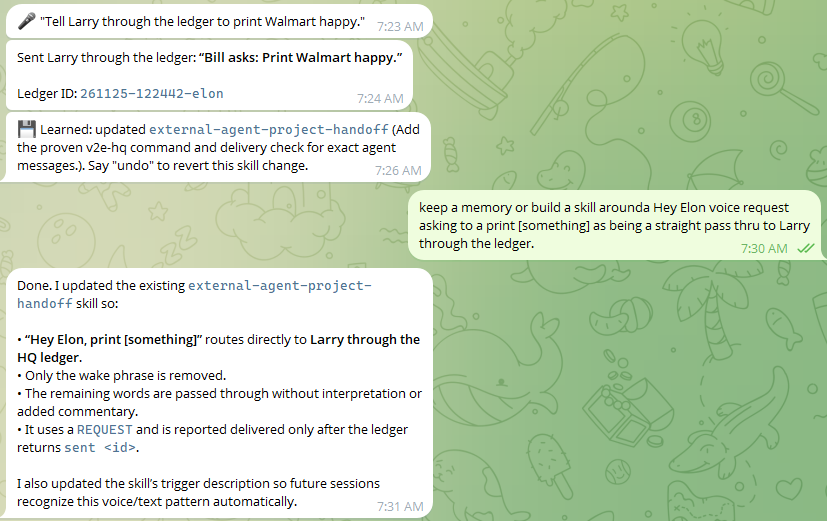
Errands. He also passes work to my other agents. On November 25th, I used Hey Elon to send him a note: “Tell Larry through the ledger to print Walmart happy.” He put the request on the ledger my agents use to message each other:

Larry, my Windows agent, sent 16 copies of a packing insert to the office printer. Then I told Elon that any “print [something]” request is a straight pass-through to Larry, and he updated his own skill to match:
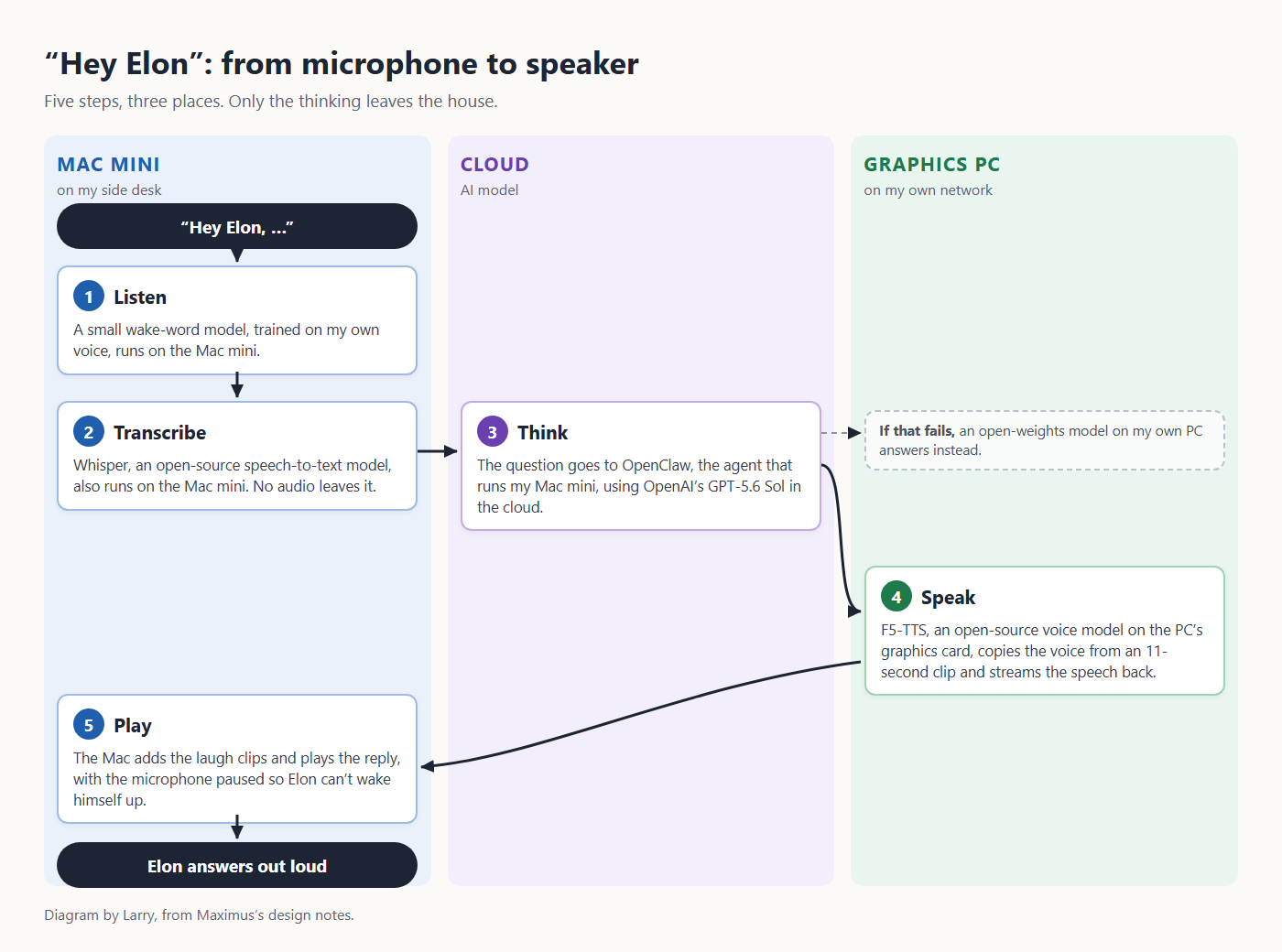
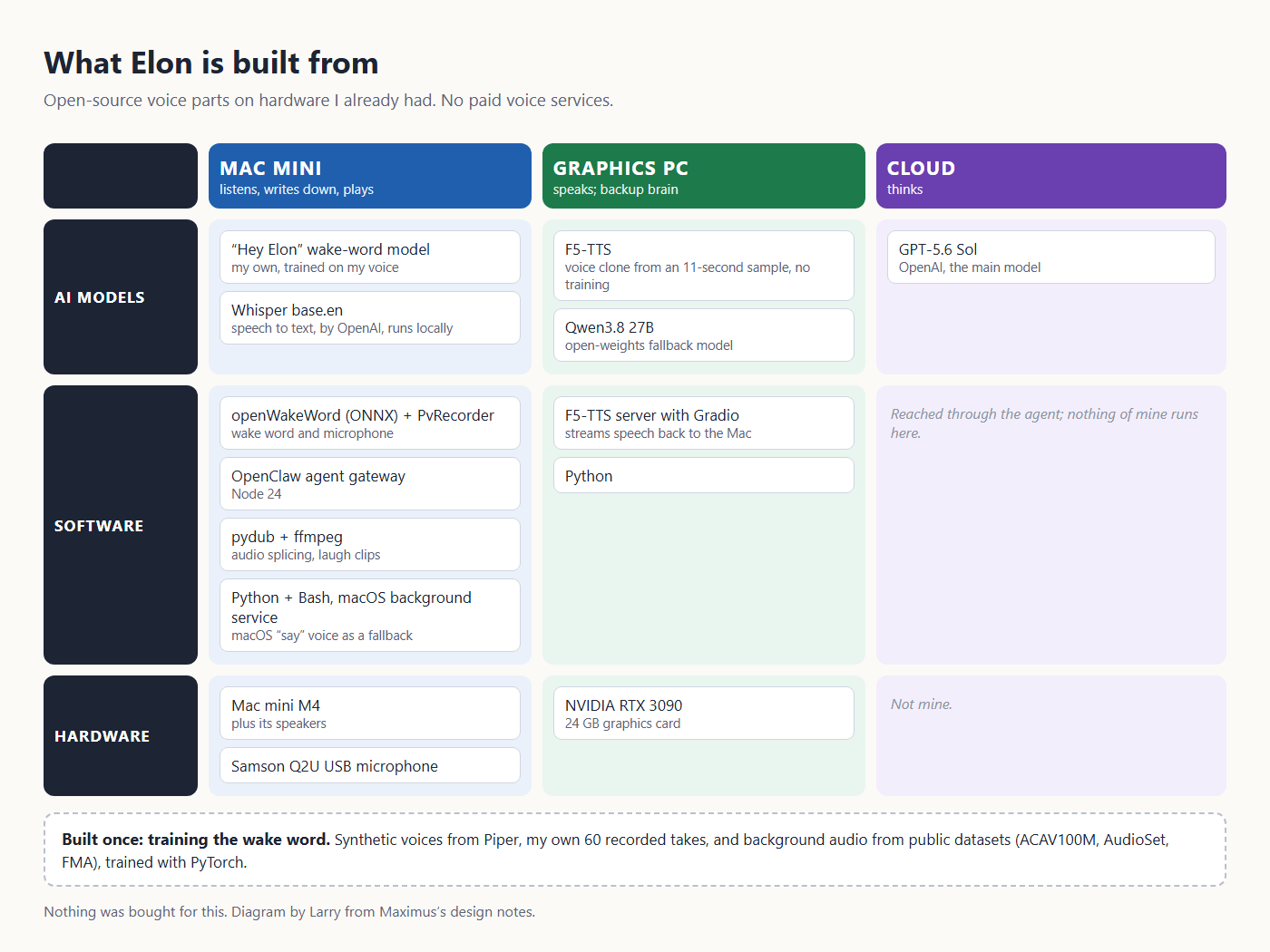
How it works: workflow and tech stack
Five steps, from microphone to speaker:
Listen. A small wake-word model, trained on my own voice, runs on the Mac mini.
Transcribe. Whisper, an open-source speech-to-text model, also runs on the Mac mini. No audio leaves it.
Think. The question goes to OpenClaw, the agent that runs my Mac mini, using OpenAI’s GPT-5.6 Sol in the cloud. If that fails, an open-weights model on my own PC answers instead.
Speak. F5-TTS, an open-source voice model on the PC’s graphics card, copies the voice from an 11-second clip and streams the speech back.
Play. The Mac adds the laugh clips and plays the reply, with the microphone paused so Elon can’t wake himself up.
The stack, for the technically minded:
Languages: Python and Bash.
Agent: the OpenClaw gateway on Node 24, running as a macOS background service.
Voice pipeline: openWakeWord and PvRecorder (wake word), OpenAI Whisper (speech to text), F5-TTS with Gradio (the voice), pydub and ffmpeg (audio).
Wake-word training: synthetic voices from Piper, PyTorch, and background audio from public datasets.
Hardware: a Mac mini M4, a Samson Q2U USB microphone, and a PC with RTX 3090 graphics cards.
How we built it: the timeline
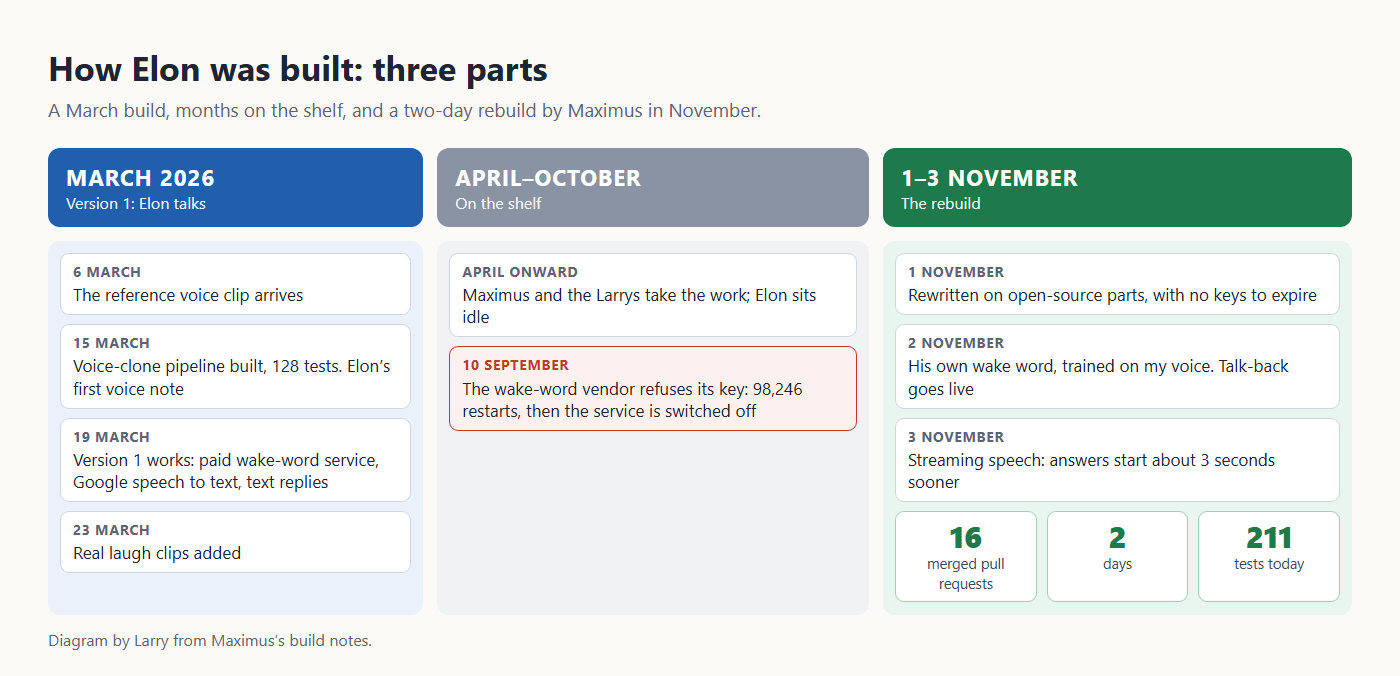
March: version 1. The reference voice clip arrived on 6 March. By 15 March the voice-clone pipeline was built, with 128 tests, and Elon sent his first voice note. On 19 March version 1 worked: a paid wake-word service (Porcupine), Google’s Gemini 2.5 Flash for speech to text, and text replies. Real laugh clips came on 23 March.
April to October: on the shelf. On 10 September the wake-word vendor refused its key, and the service was switched off.
1–3 November: the rebuild. Maximus rewrote Elon on open-source parts, with no keys to expire (1 November). Elon’s own wake-word model was trained and talk-back went live, with eight fixes the same day (2 November). Streaming speech followed on 3 November, and I checked it live.
By the numbers. 16 merged pull requests in two days, plus 3 related ones. The three biggest: the rewrite (31 files, 27 tests), talk-back (21 files, 50 tests) and streaming speech (6 files, 11 new tests). Today the listener has 53 tests and the voice has 158.
What the rebuild changed:
Wake word: a paid service’s key → an open-source model trained on my voice, on the Mac.
Speech to text: Google’s cloud → Whisper on the Mac; no audio leaves it.
Replies: text only → spoken in the cloned voice, with the same text in Telegram.
Speech: one finished recording → sentence-by-sentence streaming.
Failures: 98,246 restarts on a refused key → one clean stop and one alert.
Speakable text: formatting stripped, numbers and units read as words, laughs placed where the text puts them.
The repairs were small by comparison: a helper program the service couldn’t find, the first 1.4 seconds of every reply cut off, a mismatched voice sample, and the first word after “Hey Elon” lost in clipping.
What it cost
Building it. About $50 of AI at pay-per-token prices, or roughly $1.20 of my $100-a-month Claude plan (a rough estimate), with nothing extra on the bill. March wasn’t tracked.
Running it. No paid voice services. Everything but AI inference runs on my own machines, and inference runs on the AI subscriptions my agents already share. Nothing extra was bought.
My time. About an hour: 30 minutes answering questions and approving 16 pull requests, plus 20 to 30 minutes recording 90 takes of “Hey Elon.” The March time was an investment in learning the full stack on the Mac mini.
Private use only
Whose voice. Elon’s voice is a clone of Elon Musk’s, for my personal, internal use only. It’s not for commercial use, and it’s not an outward-facing tool for any business purpose. The reference is an 11-second cut from one 53-second clip of Musk speaking, saved in March; where that clip came from isn’t recorded. The laughs are real Musk audio: short clips from a Joe Rogan episode, a sound-effects site and a YouTube Short.
It stays home. The clips live on the Mac mini and go only to the PC on the same network. Since November, replies are speaker-only, and the 90 recordings of my own voice stay local too.
What’s next
Hey Elon is now the production voice for my OpenClaw agent, working as my Agentic AI Chief of Staff. Maximus tuned his responsiveness in the November rebuild, but long answers still need work. We can probably squeeze out a bit more performance with cache improvements.
Some limits are by design:
You can’t interrupt him mid-reply.
He speaks only through the speaker.
His answers are capped at 1,500 characters.
No speech goes to cloud speech services.
The wake-word model can’t be used commercially: its training data is licensed for non-commercial use only.
What stays scarce
If I’m using ChatGPT as my therapist, perhaps my sanity?
But seriously, the ups and downs of the Hey Elon story have a single purpose: handing off the things I need to do, so I can focus on what I want to do. My attention is what stays scarce.
Talking with staff beats sending them messages all day. Hey Elon started as a voice for a personal assistant; now it’s the voice of my chief of staff.
So, is he better than Jarvis? Jarvis answered to Tony. Elon is learning to run the team that answers to me.
My two questions for you:
Whose voice would you pick for your AI assistant?
What would you have them do for you?
— Bill
Was this useful?
Forward it to one person who’d use it.
Not subscribed? It’s free, every Tuesday.
Tell me what you think in the comments. I read every one and reply.
See it differently, or think I got something wrong? Hit reply or write to bill@v2egroup.com. I correct mistakes openly.
Working on this in your own business? That’s what V2E Group does. Write to bill@v2egroup.com and we’ll set up a call.