
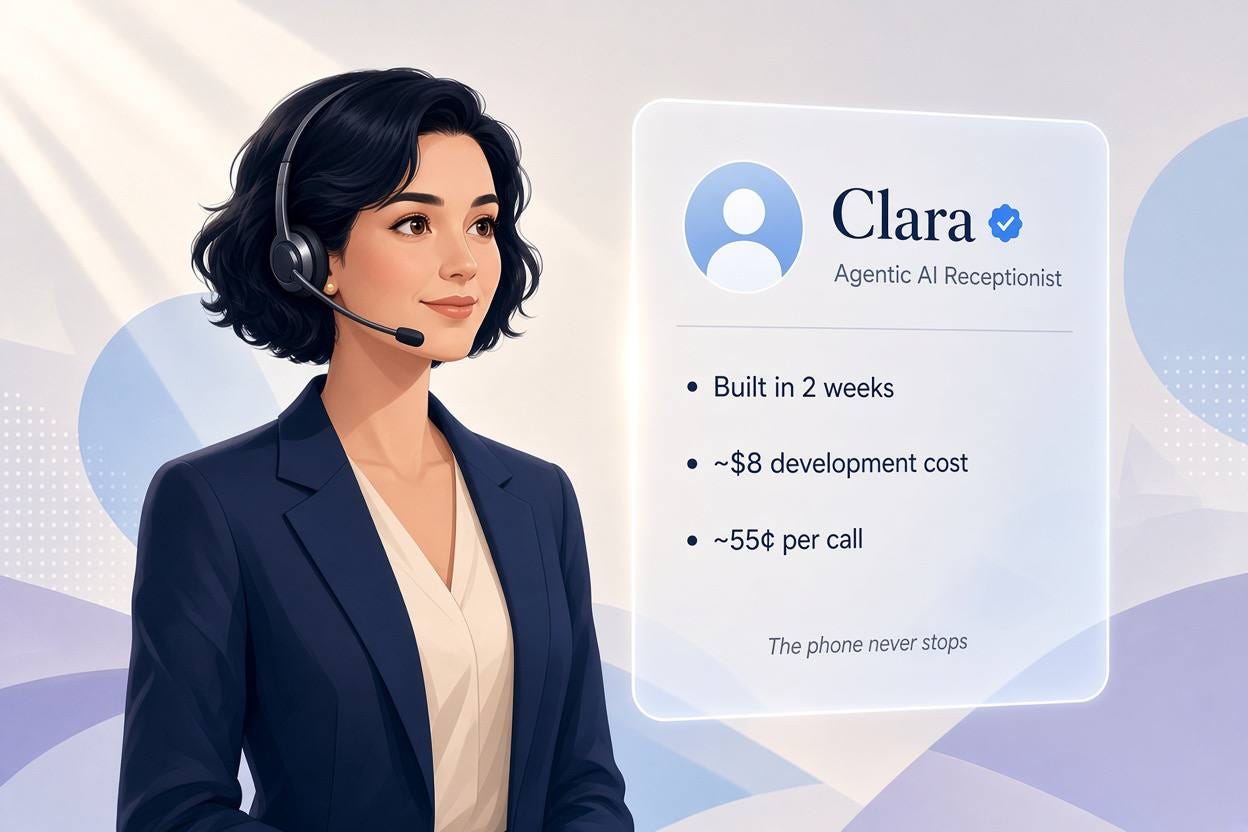
The short version: V2E’s phone is now answered by an AI assistant. She took two weeks on the calendar, roughly 13 hours of coding agent sessions, and about an hour of my actual attention. Her development’s share of a $100-a-month AI plan came to about $8.
The business case
I don’t want to answer the phone. That isn’t laziness; it’s the point of this newsletter. My attention is the scarcest resource in my business. A ringing phone spends it on whoever happens to call — prospect, recruiter, robocall, or SEO salesman. Ignore the phone and you lose the prospect. Answer it and you lose the hour.
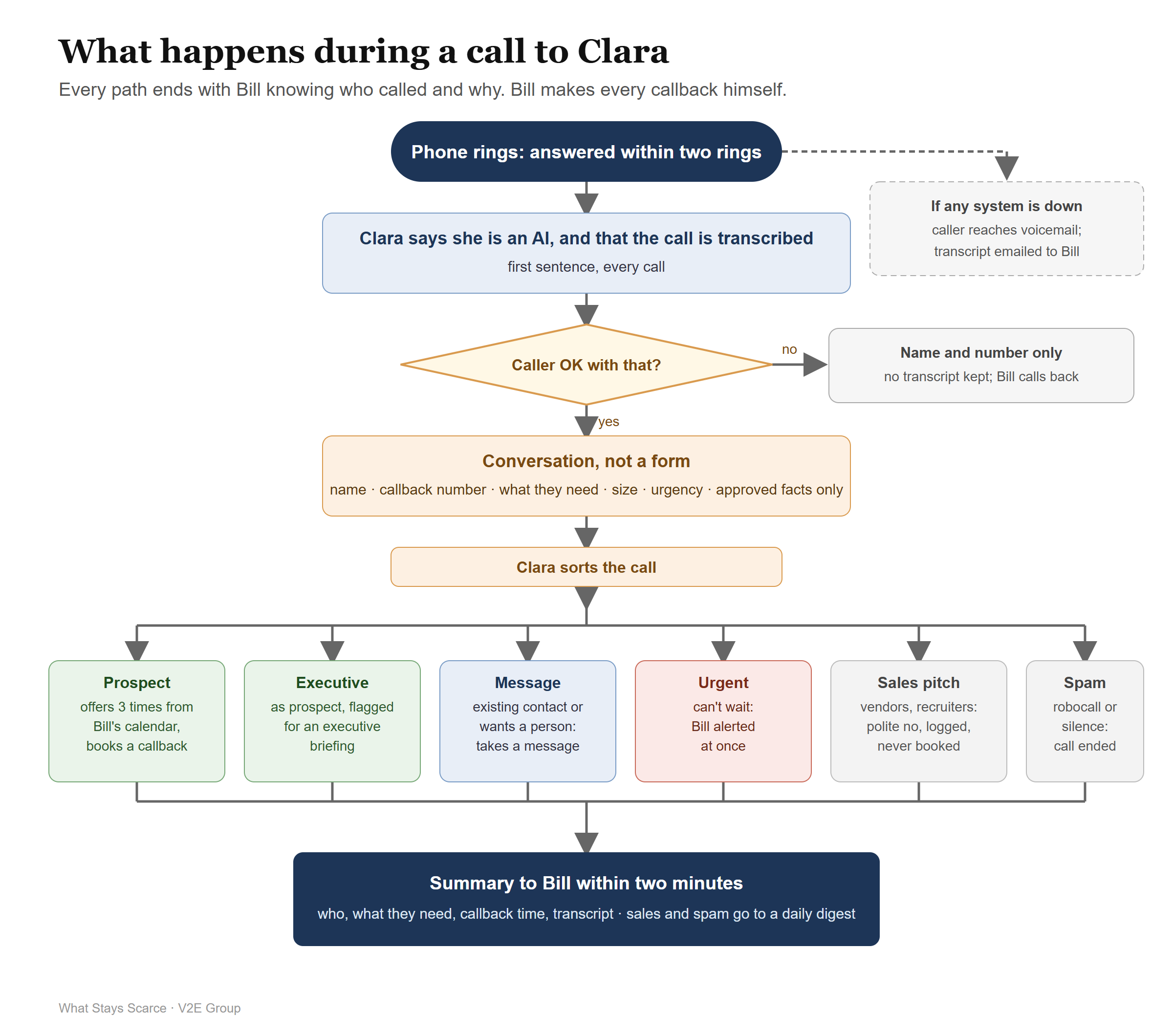
So V2E’s number is answered by an AI assistant. We call her Clara, after the voice she speaks with. Callers simply hear “I’m V2E’s AI assistant,” in her first sentence, along with the fact that the call is transcribed. She picks up within two rings, day or night, learns who is calling and what they need, answers only from a short list of facts I’ve approved, and books a callback on my calendar. Sales pitches get a polite no and never reach my calendar. Within two minutes I have a summary by email and on my phone: who called, what they need, when I’m calling them back. I make every callback myself.
There’s a second reason, and it may be the bigger one. Clara is a great demo for V2E Group. Our website promises local businesses that “the phone never stops.” Every prospect who calls V2E experiences that promise working before I say a word. And the same build, with a different facts file and a different calendar, can answer the phone for a dental practice, a contractor or a law office.
How we built it: the timetable
28 Oct: Decision: build our own rather than rent a hosted receptionist service. Specification written by Larry, the AI agent on our Windows PC; the build handed to Maximus, the AI agent on our Mac mini.
1 Nov: The phone service’s skeleton, with its security checks and tests.
6 Nov: Calendar tools: finding free times and booking callbacks on my calendar. Call summaries.
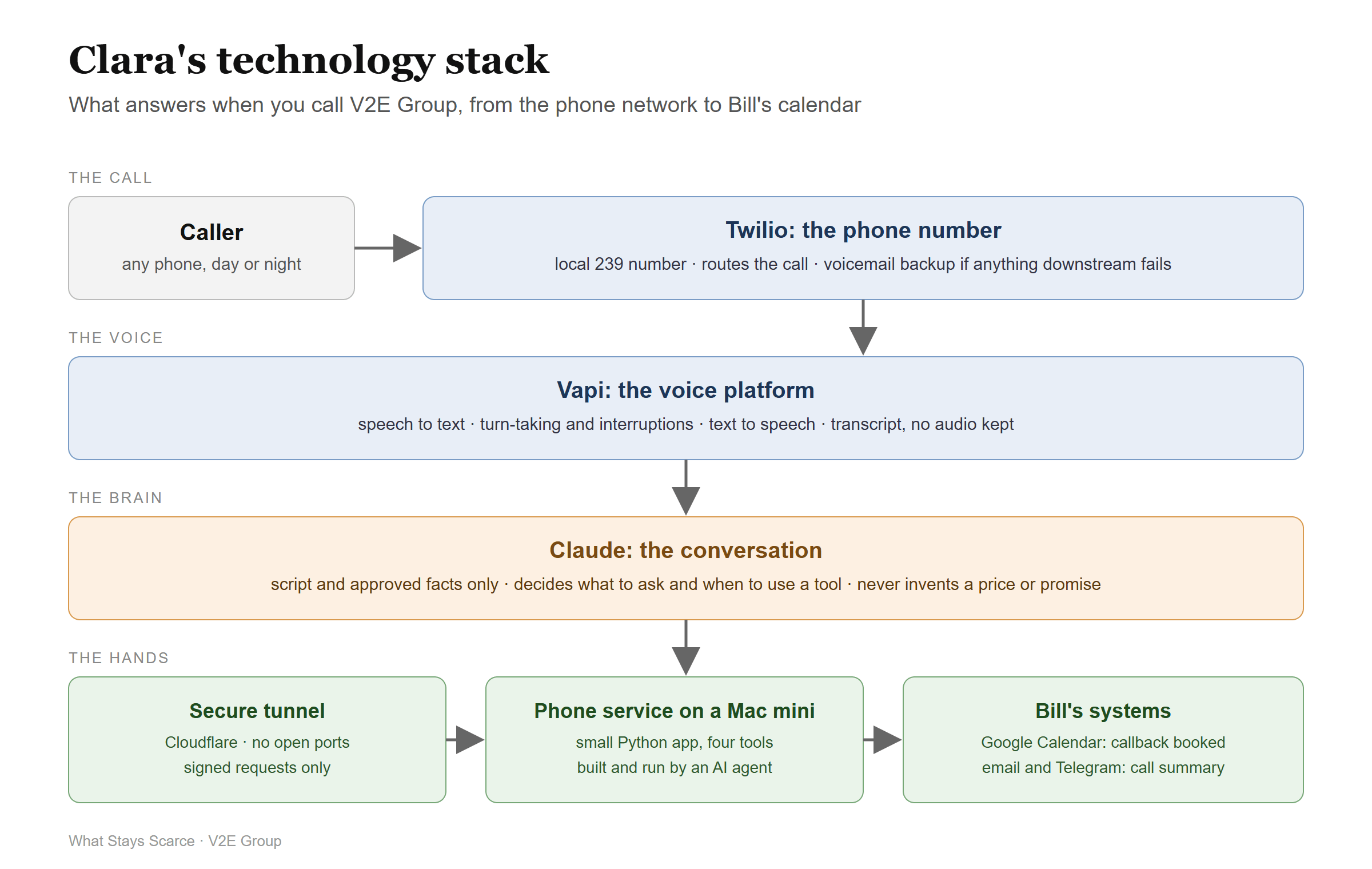
10 Nov: Accounts set up in one afternoon: the local number, the voice platform, the AI model, the secure tunnel, a send-only mail login. The assistant goes onto the voice platform; eleven test scenarios pass; my first test calls; the lawyer approves the disclosure wording.
11 Nov: Outage test (phone service down: callers reach voicemail) and reboot test pass. Number published at 8:16 a.m.
Read those dates carefully: they are not two weeks of continuous work. Clara was in development on only 8 of those 15 days, and even then she shared the day. In between, the same agents and I were busy with other projects: a server migration, a website rebuild, product listings for another of my companies, and this newsletter. The gaps in the timetable are other work, not waiting.
Where it broke: the newest Claude model hung for a minute or more on the voice platform during testing, which is an eternity on a phone call. We dropped back one generation, to a model that answers fast. On a phone, speed beats depth.
What it cost
Building it. I paid for Clara on a $100-a-month Claude Max plan, a flat fee. The plan also includes an extra $100 a month in API credit, which is what Clara’s live calls are set up to draw on. From the first decision to the last round of testing support took about three weeks, three-quarters of a month: $75 of plan. My agents did a great deal more than Clara in those three weeks, and her work used about one-ninth of all the tokens they processed. So Clara’s share of my plan came to about $8.
Metered at API rates, the picture is very different. Clara’s build alone would have cost about $174, almost all of it the agents re-reading their own context: roughly 400 million tokens. Everything my agents did in those three weeks would have cost about $1,200: sixteen times what I paid.
The lesson for an owner: build with AI agents on a flat-rate plan and take advantage of API credits. Metered pricing is for the finished product, the calls Clara answers, where every minute has a small, known cost.
My time. The session logs show about 13 hours of active sessions across 165 of my messages with Larry and Maximus. That number flatters the job. I was heavily multitasking the whole time: other business issues, engineering problems, new features for other projects with Larry, Maximus and my other agents. They all worked between my messages. Of those 13 hours, maybe 60 to 90 minutes went to Clara, and that’s being generous. Most of it was the browser tasks an agent can’t do for itself, like buying the number and approving accounts, and my own test calls.
Running it. Setting Clara up took $30 in cash, and all of it is prepaid credit that calls draw down over time: $20 with the phone carrier and $10 with the voice platform. Add about $10 a year for a domain the secure tunnel uses.
Ongoing, each phone number costs about $1.15 a month (there are two: the main line and a voicemail backup), and incoming calls cost under a penny a minute on the phone line. The voice platform charges about 9 cents a minute: 5 cents for the platform, 3 for Clara’s voice, 1 for transcription, and under half a cent for the summary. So a typical three-minute call costs about 30 cents. My seven test calls, 11 minutes in all, cost $1.00.
The one piece I’m still pinning down is the AI model’s time, which should come out of the API credit included with my plan. The tunnel and calendar are free, and the Mac mini was already on my desk.
Significant disclaimer: I doubt most human coders could get this task done this quickly and efficiently, even with AI assistance. We have thousands of GitHub pull requests of experience with coding agents using highly structured development methods and iterative process improvement:
As a non-technical business owner new to AI, you certainly can’t vibe code an agentic AI receptionist in one go with only one failed test.
If I had asked the agent who coded the task to write a prompt for duplicating this development to give a “fresh” Claude Code agent (with none of our standards or shared experience), this effort would have failed miserably — I doubt it could have delivered a working product.
I have incorporated years of experience and development standards/protocols into the constitutions of the agents on my staff. Our process has improved heavily over the last nine months - That AI development experience is an additional multiplier.
The payoff
Suppose Clara answers 60 calls a month, about three a business day, at three minutes each. Over twelve months, at the costs above, plus an allowance for the AI model’s time, plus both phone numbers and the domain, that comes to about $400 a year. Call it 55 cents a call. If her calls draw on my plan’s API credit, as they’re set up to, the model’s share costs me nothing extra and the year comes to under $300.
A receptionist in Naples earns a median of about $37,500 a year. Add benefits and the full cost is about $52,000. Clara costs less than one percent of that.
That isn’t a fair fight, and I won’t pretend it is. A good receptionist greets visitors, knows the regulars and solves problems no script anticipates, and 60 calls a month would never justify hiring one. The real comparison is the one this newsletter is about: without Clara, those calls come to me, and every one of them interrupts whatever I’m doing. At 55 cents a call, every client she books pays for her entire year. What stays scarce is preserved: my attention is free to focus on other tasks.
Where Clara goes next
Clara’s job is defined by three things I can change without me touching any code: a facts file in which I describe changes for the coding agents to spec and develop, a calendar, and a short list of tools.
That makes her easy to grow:
An additional phone number could point at the same service with its own facts and its own calendar: perhaps handle order questions for one of my other companies, or a new client’s front desk.
New tools add new skills, such as looking up an order’s status or booking a specific type of appointment.
The voice platform handles several calls at once, so a busy morning doesn’t mean a busy signal, and she is set up to answer callers in their own language where she can.
What she will not do, by design, is make outbound calls: every callback stays a person.
Here’s what I want to know from you: What calls could Clara handle for you? What’s stopping you from using something like Clara?
— Bill
Was this useful?
Forward it to one person who’d use it.
Not subscribed? It’s free, every Tuesday.
Tell me what you think in the comments. I read every one and reply.
See it differently, or think I got something wrong? Hit reply or write to bill@v2egroup.com. I correct mistakes openly.
Working on this in your own business? That’s what V2E Group does. Write to bill@v2egroup.com and we’ll set up a call.