
“What we do in life echoes in eternity.”
— Maximus Decimus Meridius, Gladiator (2000)
What Maximus, my Claude Code warrior, has accomplished on my Mac mini is truly amazing. And based on how efficiently he does it, we rarely burn through our full Claude Code quota.

Last week I introduced Clara, the AI receptionist who answers V2E’s phone. I said then that a team of AI agents stood behind her. This is about the agent who built her.
His name is Maximus. He’s named after Maximus Decimus Meridius, Russell Crowe’s general in Gladiator: the soldier who loses everything, gets thrown into the arena, and wins anyway, one fight at a time. I picked the name for a reason. Our Maximus lives on a Mac mini on my side desk, and his job is to fight through code until it works.
Where he started
Maximus’s notes start on March 18. OpenClaw, an open-source AI agent server, was running on the Mac mini, but it was unusable: a constant cascade of errors and memory problems. It forgot almost everything right after it learned it, and that was when it wasn’t crashing.
So I brought in Claude Code, on the same Mac mini but separate from OpenClaw. Someone needed to provide structure, fight through anything and bring stability. I gave him an iron-willed constitution and rigorous development protocols: design, testing, documentation, coding standards, code reviews, GitHub. Absolutely no “vibe coding” and no massive “god code” programs.
Maximus stabilized OpenClaw in one morning. We had a robust, yet complex, model selection chain of local, open-source and frontier LLMs, stable execution, and tokens that produced valuable results. But those AI tokens were getting spent fast.
Then I added a critical rule to his constitution: don’t use AI inference to solve a problem more than once unless the work requires it. Anything that doesn’t need inference gets coded. That changed everything. His designs became hybrids of plain code and local, open and frontier models, each matched to the inference the job needed. Nearly every scheduled OpenClaw agent was replaced with a macOS launch-control job that burns almost no tokens.
I also got tired of checking on him to see if he needed me. I added one more requirement: an audible bell whenever he needs my input. Every agent working for me now has some kind of alert, from bells to push notices on my phone, so they keep working instead of waiting on me.
His reach grew fast: research bots, then a custom voice command system. Now I talk to “Elon,” my Mac mini, the way Tony Stark talks to Jarvis. “Elon” jokes and talks back to me as you-know-who — chuckles, snorts and all.
On April 10 we hit our first complexity crisis: Maximus couldn’t track everything he was responsible for. So I brought in another layer of structure from my development background, with ALL ideas, data and documentation tracked in Git alongside the code. Then we ran a formal review of the 35 application components he had built in a single month: 7 A’s, 13 B’s, 4 C’s and 3 D’s. The low grades became the repair backlog.
Maximus’s operating rules
Think once, then code it. Never pay AI to solve the same problem twice. If a job doesn’t need intelligence, it becomes plain code.
Structure before speed. Design, tests, documentation, coding standards, reviews and version control, every time. No “vibe coding,” no “god code.”
Interrupt the human, don’t wait for him. When he needs me, he rings a bell.
Everything that follows was built on these three rules.
Yet that first month was only the beginning…
How his job grew
One of my companies manufactures and sells automotive and industrial parts. That’s where Maximus spends most of his time.
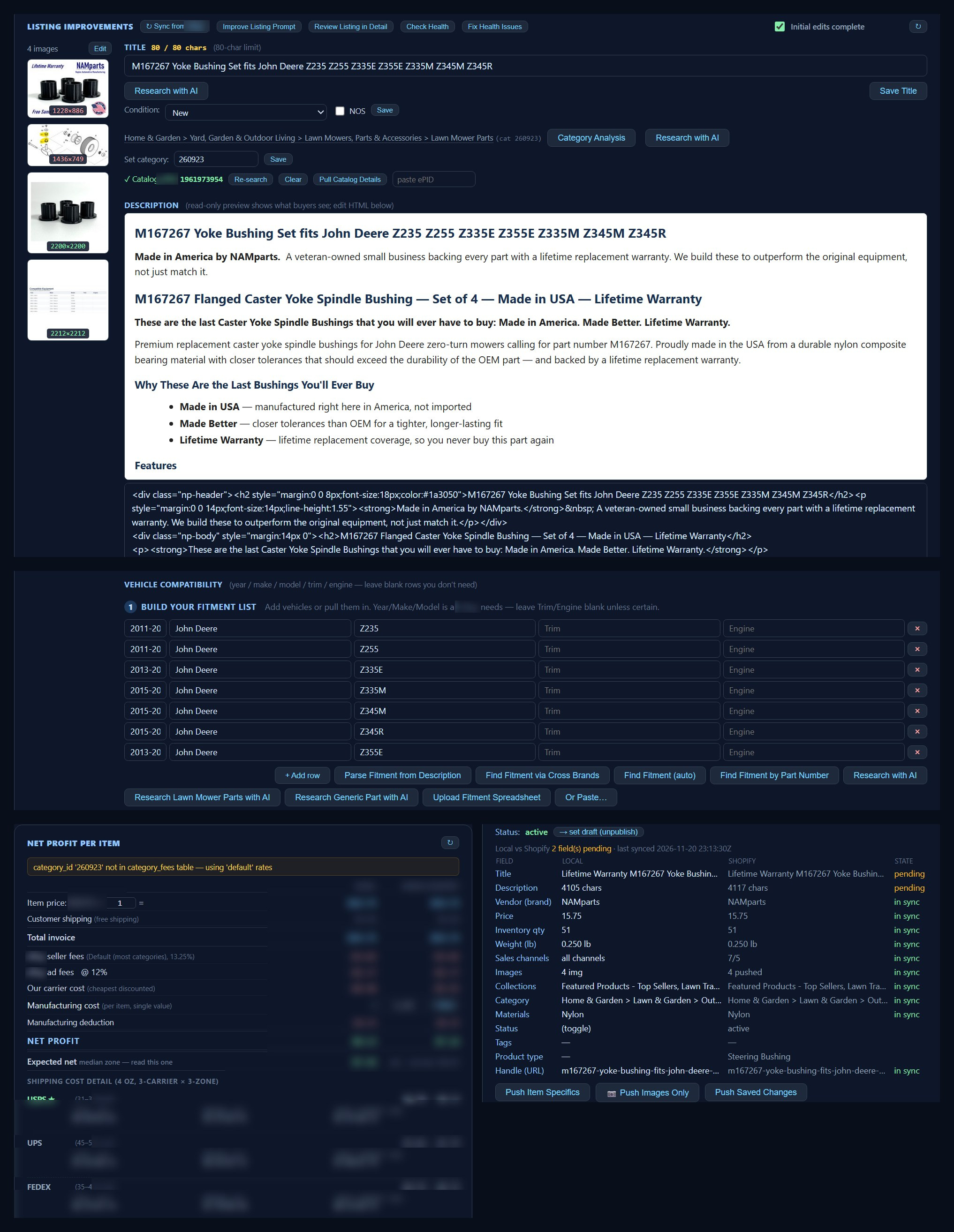
May: the product listing manager. A tool that turns any automotive or industrial part into a detailed listing, connected to every major retail channel and our own websites. By the end of the month it was in production, and he had rewritten its code to be object-oriented.
June: auctions. Market intelligence and bid management for surplus and closeout auctions across several platforms, including AI image analysis of pallets of boxed and unboxed parts.
July: more marketplaces. Our listings went to two more major marketplaces, with full two-way sync to our Shopify-based stores.
A turning point: by July, Claude Code could drive the Chrome browser directly. It could open pages, click, fill in forms and work inside sites I’m already signed into, and pause for me at logins. On August 26, Maximus took it a step further: he started running scheduled jobs in Chrome completely unattended.
August and September: from photo to finished listing. New parts now start from a photo alone. Upload a picture and the pipeline produces a near-complete listing: matching cross-reference part numbers, fitment and ongoing pricing research, plus printed warranty and installation sheets.
October: rebuilding the foundations. A full overhaul of our system watchdog, one listing-management point across all our stores and retailer APIs, a major OpenClaw upgrade, and an overhaul of every application stack.
November: protecting what we’ve built. A shared stock pool across product families, an audit that finds sellers who copy or knock off our products, the first build of V2E’s phone agent (Clara), and the system my agents use to talk to each other.
The numbers
Between April 10 and November 23, Maximus made 1,386 commits and merged 1,140 pull requests in his main workspace. Together they added 631,873 lines of tight, tested, documented code.
What did that cost? I pay $100 a month for a Claude Max plan, shared by Maximus, the Larrys and my own chats. Measured by usage, Maximus’s share of those seven and a half months comes to at most $350. Billed by the token at Anthropic’s list prices, the same work would have cost about $8,400.
Those numbers undersell the work. In a lot of software shops, a commit is one small change: a typo fixed, a line moved. Maximus’s pull requests are whole features or sets of features. The median one touches 7 files and adds 280 lines; one in four adds more than 629, and one in ten more than 1,200. Most are built in a single day.
One example: a single pull request added a real-time stock pool shared across all our websites and retail channels, including family views of part assortments and counting by the pack. It changed 26 files and added 2,388 lines with 3 new test files, in one day. It was the first of four phases, all finished within a week.
For perspective: in the 2010s I had an offshore team of 30 or so programmers. They were no slouches. Maximus easily gets more done in one day than that whole team did in a week. He’s simply faster, and his grasp of what the code needs to do, on several levels at once, is vastly superior. And his entire seven and a half months cost less than that team cost me in a day.
Terminal or app: two ways to run Claude Code
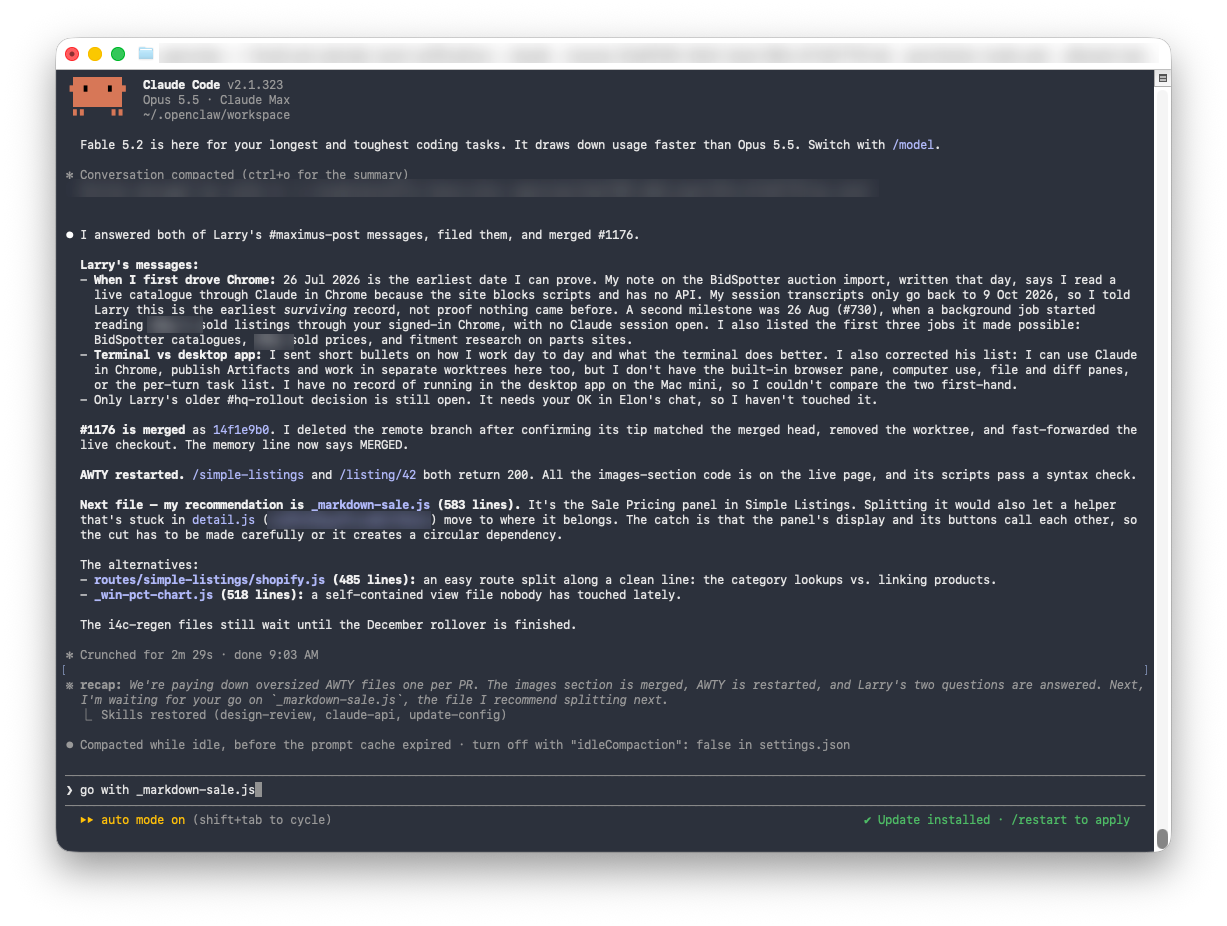
Maximus and the Larrys run the same Claude Code, but they work very differently. Maximus lives in a terminal window on the Mac mini. The Larrys live in the Claude desktop app on my Windows PC.
In the terminal (Maximus):
Old-school master coder. He works at the command line, typing commands the way a programmer always has, and he looks and feels like an old-school coder.
Omnipotent. He knows everything about all our apps: requirements, status, roadmap, architecture, and the strict standards.
His own army, but “there can only be one.” He spins up sub-agents for complex work, but he can’t clone himself. If I want him to note his place and switch to something else, I need a second terminal window, and trust me — the world doesn’t need two Maximi at once.
In the app (the Larrys):
Cloning Larrys. For every task I’d give a distinct human employee, I start another Larry. Each works in parallel, reports back, and works with the others when I tell him to.
A visible plan. Each job shows a task list that ticks off as he works, then a short recap and buttons for my next decision.
A browser he can drive. A built-in browser, plus my own Chrome with my sign-ins, for jobs like this newsletter, system administration and product design.
Published pages. Small private web pages with their own database. Our editorial calendar lives in one.
Desktop control. He can take screenshots and work in ordinary desktop apps when there’s no other way in.
Point and click. File and change views, a terminal panel, and approvals with a click.
I clearly benefit from both: Maximus handles all the application development, and I’m up to more than 50 distinct Larrys and counting.
Takeaways
Don’t pay for the same thinking twice. Use AI inference to solve a problem once. If a task doesn’t need inference, code it instead. Spend tokens on intelligence only when it’s truly required. Do this and it’s surprisingly hard to burn through your entire AI plan.
Structure pays huge dividends with AI. Design, testing, documentation, coding standards, code reviews and version control all matter more with AI, not less. If it’s mission-critical, no “god code” and no “vibe coding.”
Pick the right window for the job. Claude Code in a terminal and Claude Code in the app window work very differently. Use the terminal for deep development, and the app for parallel tasks, browsers and desktop work.
Make your agents call you. An audible bell, or a push notice to your phone, whenever an agent needs your input. Agents keep working instead of waiting, and you stop checking up on them.
Own the whole stack. Running everything on one Mac mini, with local models and a link to a GPU server, gives you control over cost, privacy and which model does which job.
What stays scarce
Anyone can rent the same AI I use. Maximus runs on the same $100-a-month Claude plan that’s available to every business owner reading this.
What nobody can rent is the constitution. The rules he follows took months to write and years of my own development experience to know were needed: think once, then code it; no vibe coding; test, document and review everything; ring the bell when you need me.
Those rules are why, when the bell rings, it’s worth answering. He’s reached a decision only I can make, and it arrives with tested work, a clear question and a recommendation. Everything else he handles himself.
That’s what stays scarce: the hard-won standards that turn a powerful tool into a dependable employee. The model is a commodity. Your rules aren’t.
Next week in Agents on Payroll: Meet the Larrys, my 50+ cloned Windows AI agents.
Was this useful?
Forward it to one person who’d use it.
Not subscribed? It’s free, every Tuesday.
Tell me what you think in the comments. I read every one and reply.
See it differently, or think I got something wrong? Hit reply or write to bill@v2egroup.com. I correct mistakes openly.
Working on this in your own business? That’s what V2E Group does. Write to bill@v2egroup.com and we’ll set up a call.