
An AI agent took my father’s line back to 1790s North Carolina, then confidently started misreading 18th-century longhand. Sit next to your AI agent for an hour and teach it how people used to write with turkey quills in permanent ink by candlelight.
The challenge
At the end of his Saturday show on 31 October, Anthony Pompliano challenged his audience to turn AI agents loose on their family history (watch from 49:47). The next day he posted what his own “Genealogist Bot” had done: asked to go as far back in his family lineage as possible, it found marriage licenses, birth certificates, ship manifests and relatives he never knew existed. He called it one of the better experiences he’d had with AI, and told everyone to set up their own.
I took him up on it.
Meet the Larrys, briefly
A single Larry is an agentic AI on my Windows PC. The Larrys are a Claude swarm of agents: architects, coders, analysts and sysadmins. Most days the Larrys work on applications, documents, servers, email and administrative support. They’ll get their own post on a coming Tuesday. For now, all you need to know is that a Larry works hard, writes everything down, and is very sure of himself.
The task
I gave Larry everything I knew about my father’s line and asked him to work it back as far as he could. He spent the first week of November pulling census pages, deeds, court minutes and marriage bonds, cross-checking indexes, and logging every reading with its source.
The 1900s and 1800s went quickly. Typed indexes, printed census sheets, newspapers. Then he reached North Carolina in the late 1700s, and the trail ran into the courthouse.
The roadblock
Old courthouse records are handwritten with a quill, photographed onto microfilm decades ago, and scanned since. The ink has faded, the paper shows through, and every clerk has his own hand.
Larry could still read them. He was fast, and he was confidently wrong.
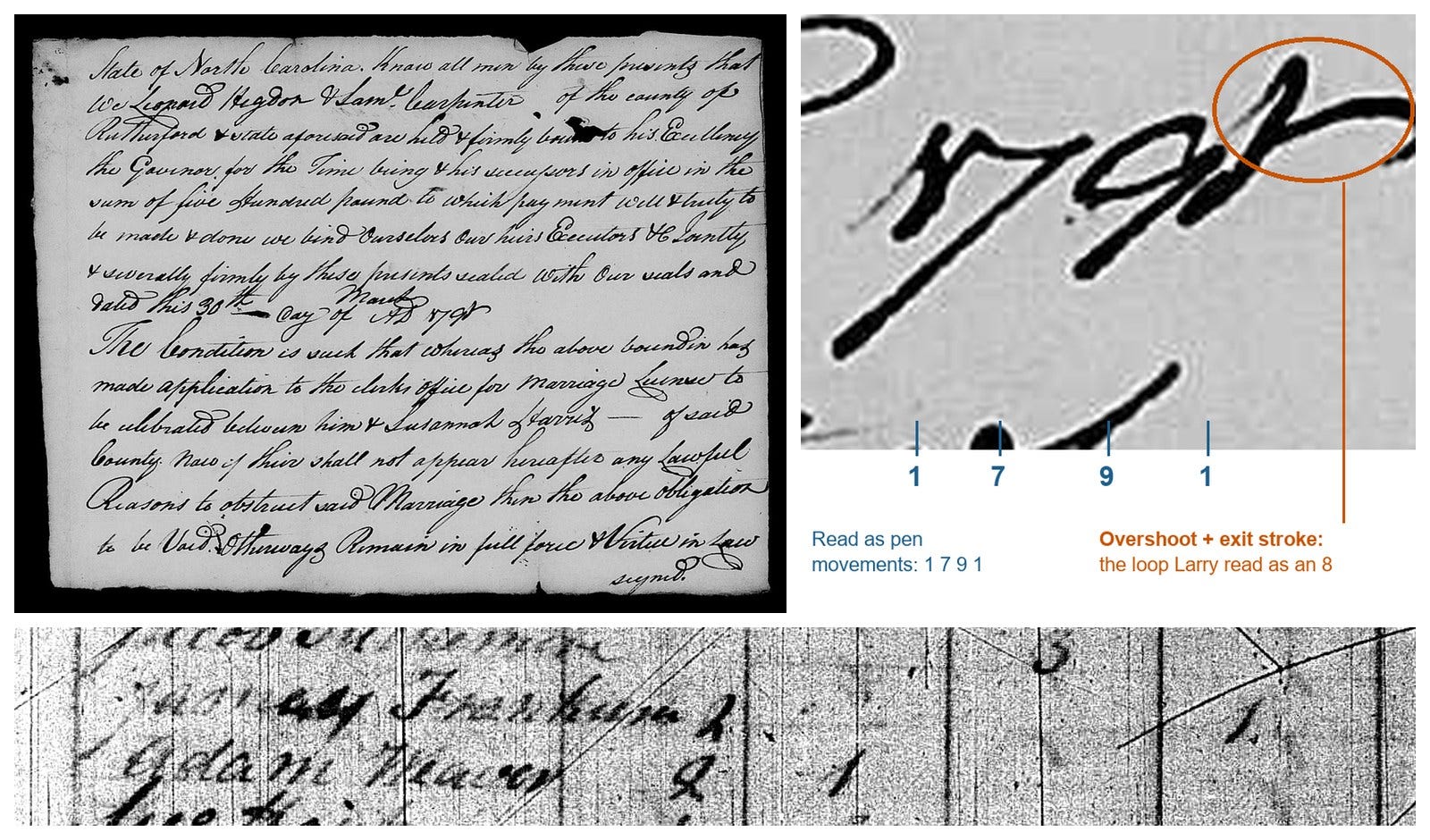
On the 1810 census he read a name as “Jamsey Frankum” and closed the lead. It was James Franklin, the man we were looking for.

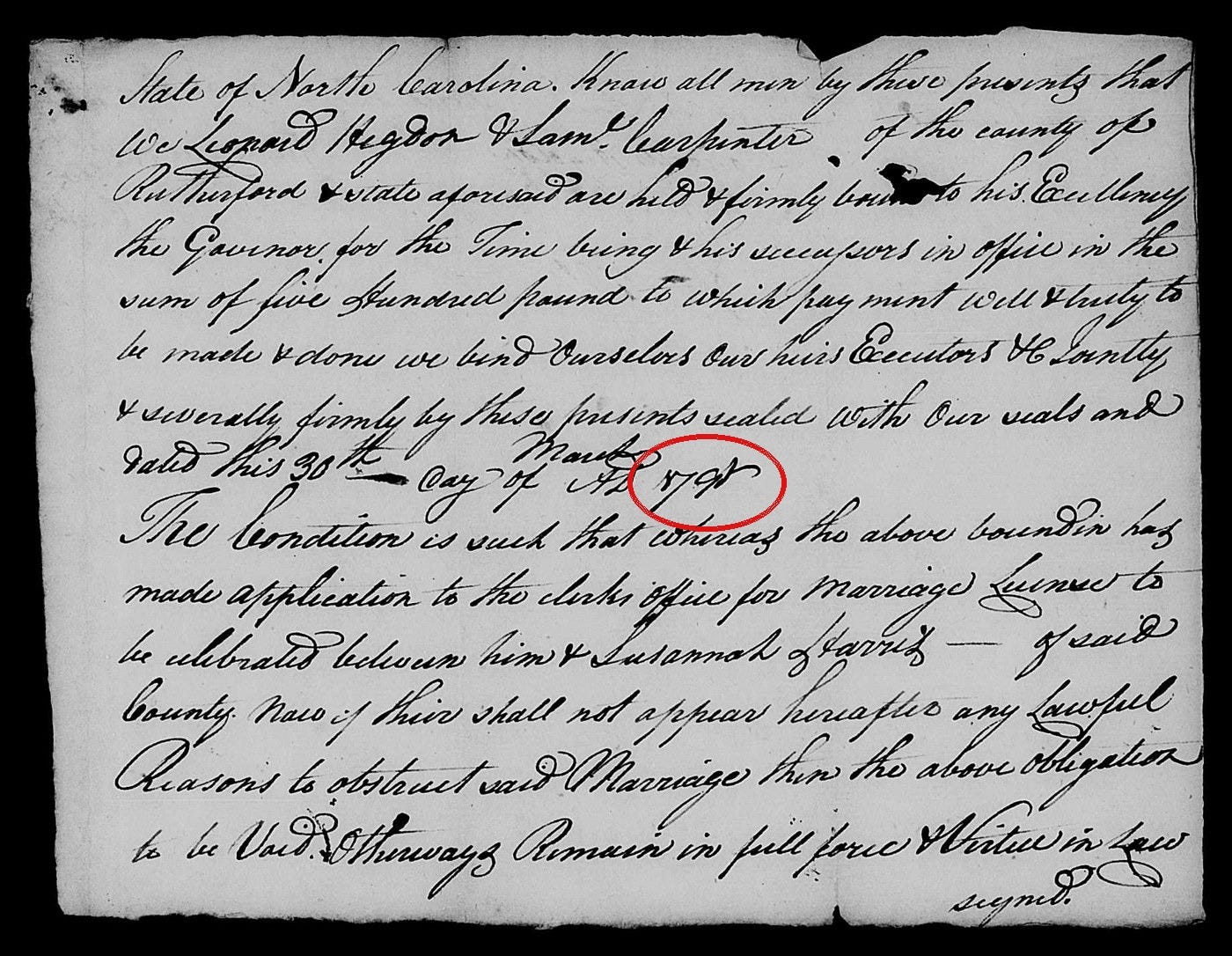
On a Rutherford County marriage bond dated 30 March 17-something, he read the year as 1798. His note said the last figure “is looped and is most like an 8.”
The teaching
I love the art and aesthetics of classic handwritten documents. I practiced calligraphy as a teenager, and I could see what had happened. So instead of just giving him the answer, I told him how the writer’s hand moved to write 1791 at the end of a line before starting the main paragraph of the document:
After the date, the writer needs to get to a new line. In this case it starts with an enlarged leading word, a flourish. He’s thinking ahead to that more than the date, which he knows anyone concerned can read.
So he lowers the quill to the top of the 1, traces down heavy, and lifts. He writes the top of the 7 with the slight drop typical of the time, then the dramatic slash to the lower left. Lift. He goes to the top right of the 9, makes the circle counter-clockwise, then the stroke down to the bottom left. Lift.
Then the last 1. Down and to the right, then up for the stroke, which he overshoots. Muscle memory brings him back down that stroke to where the 1 should have ended. Then he moves the quill quickly up and out to the right, changing direction to get to the next line.
He’s got to keep moving fast so the ink doesn’t blot. And the quill is fragile. The two nibs are an organic material, not always predictable.
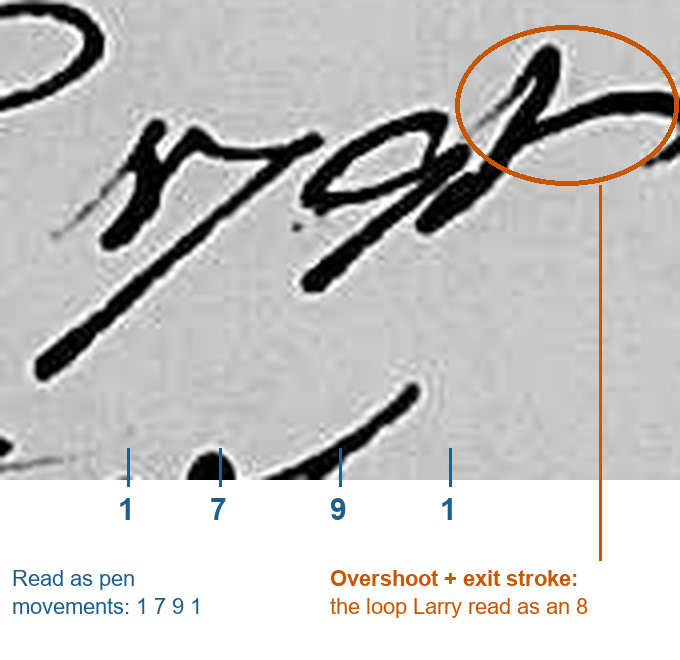
The “loop” Larry took for an 8 was the overshoot plus the exit stroke. A real 8 needs its own crossing stroke, and it isn’t there. The year is 1791. “Jamsey Frankum” was the same mistake: ink drag read as letters.
I added one more thing. In the late 1930s, Works Progress Administration (WPA) workers typed abstracts of these same bonds from the paper originals. Their abstract says 1791. That typist lived in a world where nothing was hand-printed, little was typed, and almost everything was written in a personal hand, each one as distinctive as a fingerprint. Today most adults and children can’t read longhand at all. When a period reader and a scan disagree, the period reader deserves real weight.
What Larry did with it
Larry didn’t just change 8 to 1. He rewrote the rule he works from:
Reconstruct the stroke order. Before any reading of a hard passage, describe the strokes that produce it, and check them against the same writer’s other letters on the page.
Ask what the writer was doing next. Ends of dates and lines are rushed. Expect overshoots and exit tails.
Allow for the tool. A quill that has to keep moving, a split nib, fading ink, grainy microfilm.
Give period readers real weight. The WPA typist read the original.
Bring the crop to Bill. Mark a doubtful reading “[?]”. Never invent a name or a figure from pen marks.
The results
The lesson took me a few minutes. The rule went into Larry’s memory, and he works from it on every document now.
The next morning showed the difference. On the 1800 census, Larry proposed that a run of looped figures were 1s, reading them by stroke order, and he was right. He spotted faint marks on the 1810 page as ink bleeding through from the facing page instead of reading them as tallies. Doubtful figures came to me marked “[?]” instead of closing a lead.
Then a 1769 deed, the oldest record in the tree. Larry read the date, the price and a patent date nobody had read before. He worked out that the bounds had to be 180 poles to fit the 200 acres. I read the faint witnesses’ names and the name of the boundary creek. Question sheet to finished reading took under an hour.
Larry didn’t learn to read like the WPA typist. He learned how to look, when to doubt himself, and when to ask. With that, the two of us got the tree back to 1769.
Your turn
Pomp was right. Set up your own genealogist bot. When it hits the courthouse, sit next to it for an hour and teach it how people used to write with turkey quills in permanent ink by candlelight.
— Bill
Was this useful?
Forward it to one person who’d use it.
Not subscribed? It’s free, every Tuesday.
Tell me what you think in the comments. I read every one and reply.
See it differently, or think I got something wrong? Hit reply or write to bill@v2egroup.com. I correct mistakes openly.
Working on this in your own business? That’s what V2E Group does. Write to bill@v2egroup.com and we’ll set up a call.